How to calculate your daily intake without overcomplicating it
Start with an estimate, observe your trend, then adjust based on real data instead of panic.

Your maintenance calories are not a fixed truth. They are a starting estimate refined by your body-weight trend.

01 / Calories
The unhealthy habit
People often copy a number from a friend, influencer, or calculator and treat it like law. When weight does not move after three days, they slash another 500 calories. That turns nutrition into noise.
A calorie target is not a moral score and it is not a prophecy. It is a starting hypothesis. Your true maintenance changes with body size, daily movement, training, sleep, stress, and how accurately you log. [1] The goal is to pick a reasonable starting point, collect enough data, and adjust calmly.
02 / Calories
The better adjustment
Estimate maintenance with body weight, activity, and goal. Track intake and morning weight for 14 days. If the average weight is stable, you found a rough maintenance. For fat loss, reduce modestly. For muscle gain, add modestly.
The important part is using averages. A single weigh-in can be water, sodium, digestion, soreness, or a poor night of sleep. A 7- to 14-day trend tells a better story. [1] If your average intake is 2,200 calories and weight is stable, then 2,200 is more useful than any calculator. If your target is fat loss, a small reduction is usually more sustainable than a dramatic cut.
03 / Calories
How CrosWeight helps
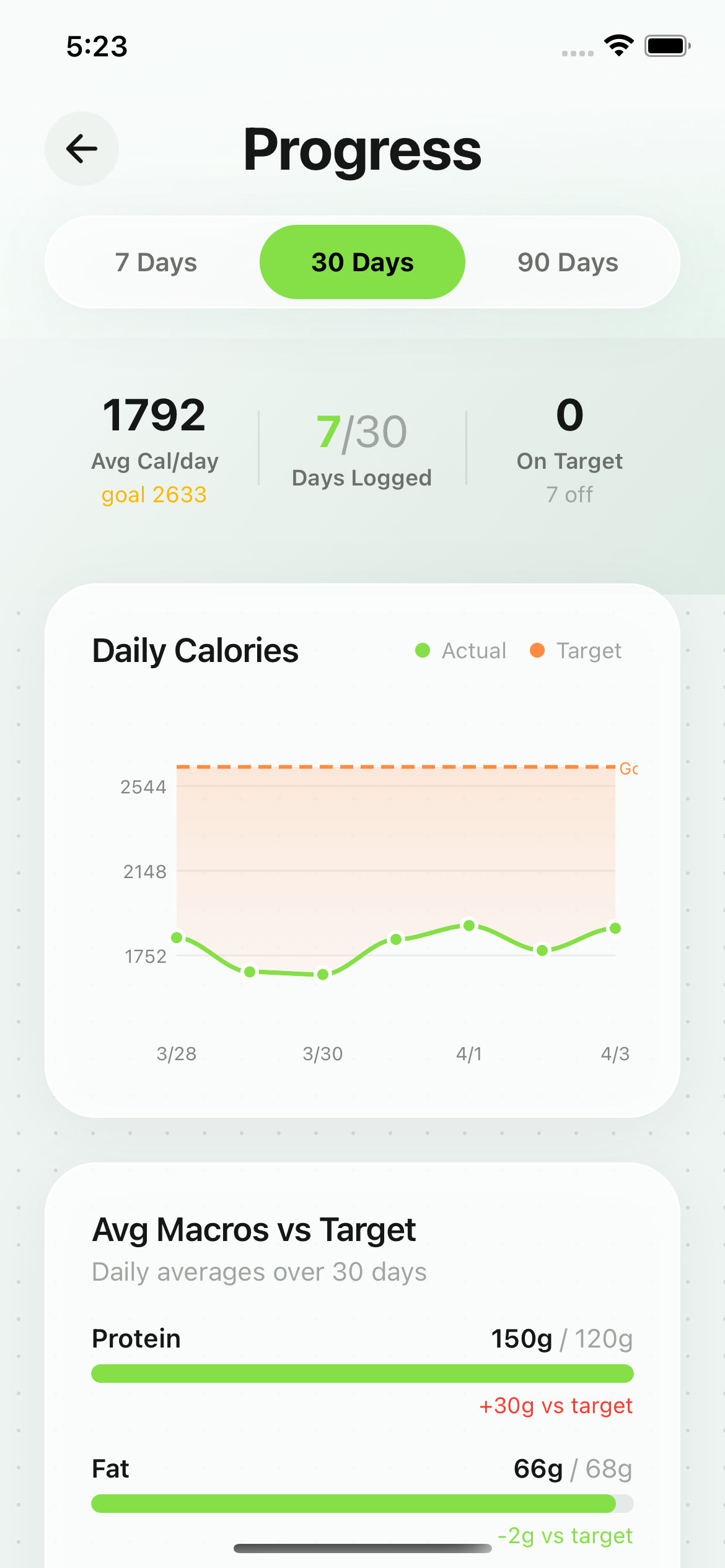
CrosWeight connects your meal log with your trend. That helps you adjust from evidence instead of emotion: if your average intake is consistent and weight is stable, the next change can be small and precise.
This is especially useful for people who feel stuck. Instead of asking, "am I doing everything wrong?" you can ask a better question: "what does my actual average intake suggest?" That shift makes nutrition feel like a feedback system instead of a cycle of starting over.
Try this week
Turn the idea into a 7-day experiment
Pick one behavior from this article and test it for a week before changing anything else. Nutrition gets confusing when every variable moves at once. Keep your meals familiar, log them consistently, and look for the pattern that repeats.
At the end of seven days, compare your average intake, hunger, energy, and weight trend. If the trend is moving in the right direction, keep going. If it is not, make the smallest adjustment that targets the actual bottleneck instead of restarting with a stricter diet.
CrosWeight note
Where CrosWeight fits
The app is most useful when you want less friction between eating, logging, and learning. In this guide, that means:
- Track meals quickly with AI
- Review daily and weekly averages
- Use weight trend to adjust intake
Sources